The following table represents the OHIE reference technologies. It is a list that is expanded as new workflows and use cases are added. See the Architecture Maturity model that describes the business processes that these tools support. MEDIC CR Open Enterprise Master Patient Index (OpenEMPI) is an open source implementation of an Enterprise Master Patient (EMPI) which is a repository that maintains a registry of all patients across an enterprise. An EMPI provides many benefits including: Open Source Human Resource Infomation System (iHRIS) is an open-source software that supplies health-sector leaders with information to track, manage, and plan the health workforce. iHRIS captures high-quality data on health worker numbers, skills, qualifications, locations, and more. OpenInfoMan is XQuery and RESTXQ based implementation of the Care Services Discovery (CSD) profile from IHE which implements the following actors and transactions: OpenInfoMan has been developed as part of OpenHIE and is intended to be the engine behind the CSD compliant Health Worker Registry and to be incorporated in OpenHIM.OpenHIE Component
Application
Links to Software
Software Description
Interoperability Layer 
OpenHIM - GitHub Open Health Information Mediator (OpenHIM) is a middleware system that aims to enable easier interoperability between disparate health information systems; essentially this piece of software allows difference systems to talk to each other and exchange information. Terminology Services 
DTS Web site with Links to software Distributed Terminology System (DTS) is an integrated set of open source components that provides comprehensive terminology services in distributed application environments. DTS supports national and international data standards, which are a necessary foundation for comparable and interoperable health information, as well as local vocabularies. Typical applications for DTS include clinical data entry, administrative review, problem-list and code-set management, guideline creation, decision support and information retrieval. Client Registry 
MEDIC CR - GitHub MEDIC Client Registry is a master patient index developed under Mohawk College's Natural Sciences and Engineering Research Council of Canada (NSERC) grant to build and a test version of the pan-Canadian Electronic Health Record System blueprint as prescribed by Canada Health Infoway. This reference implementation project is intended to assist developers in the development of Client Registry software, customer interfaces (as a test interface), in demonstration XDS infrastructures, or in staging environments. Client Registry 
OpenEMPI - Website Shared Health Record 
Software Repository Open Medical Record System (OpenMRS) is a collaborative open-source project to develop software to support the delivery of health care in developing countries. OpenMRS provides an electronic medical record platform that allows a number of add-on modules to help OpenMRS function better for you. Health Management Information Systems 
DHIS2 - GitHub District Health Information Software (DHIS) is a highly flexible, open-source health management information system and data warehouse. DHIS provides routine data, semi-permanent data (staffing, equipment, infrastructure, population estimates), survey/audit data, and certain types of case-based or patient-based data (for instance disease notification or patient satisfaction surveys). Facility Registry 
ResourceMap - GitHub Resource Map is an open-source tool free to use in the cloud or locally installed, that helps you make better decisions by giving you insight into the location and distribution of your physical infrastructure. With Resource Map, you and your team can collaboratively record, track, and analyze resources at a glance using a live map. Health Worker Registry 
Interoperability Service Entity Matching Service The purpose of the Entity Matching Service is to enable matching in a single list of patients, health workers, facilities or other entities or to find potential matches between two lists of the same entities. Interoperability Service. OpenInfoMan Info Manager : Find Matching Services (Ad-Hoc and Stored) [ITI-73]
Query for Updated Services Transaction [ITI-74]
Services Directory : Query for Updated Services Transaction [ITI-74]
OpenHIE Architecture
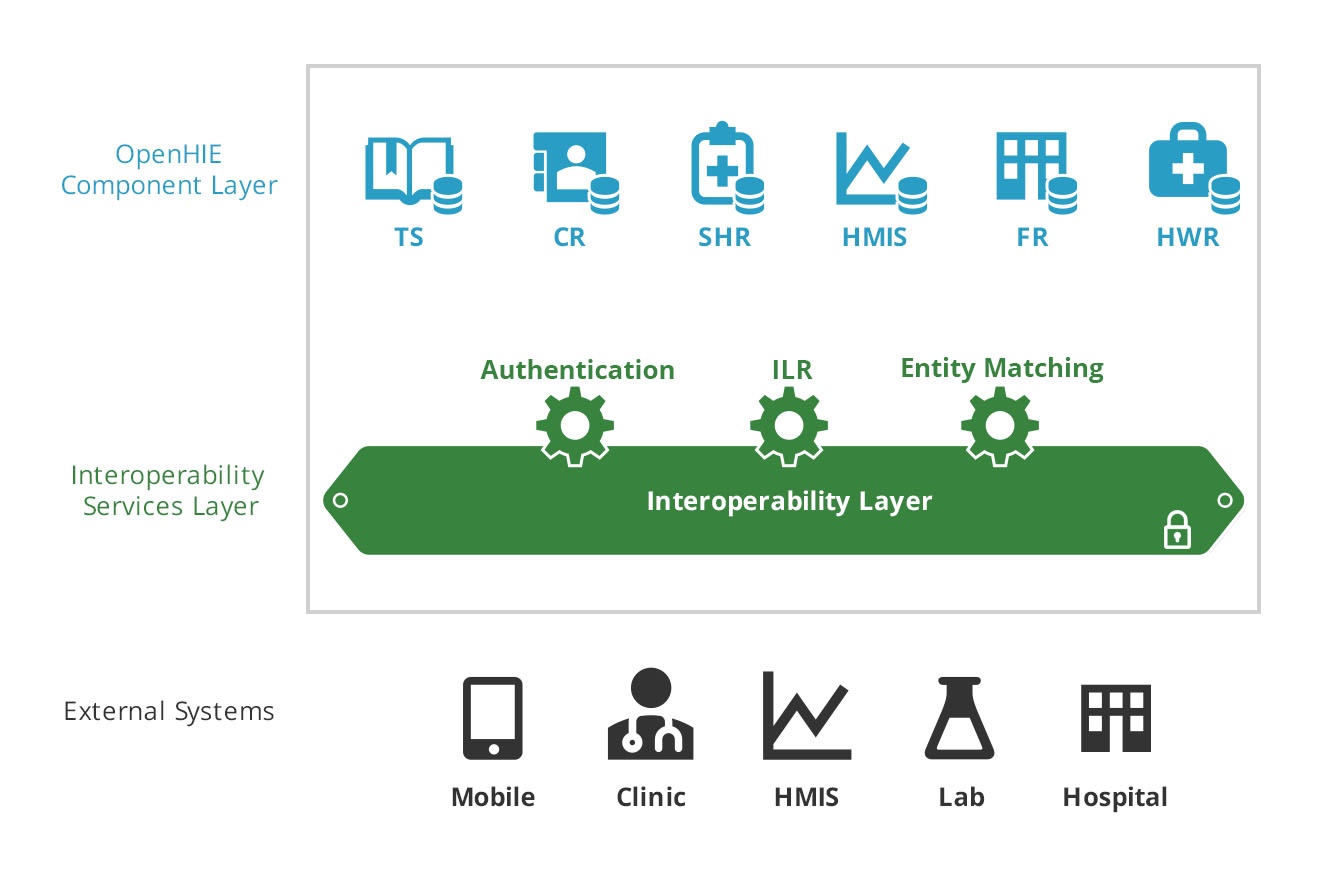
OpenHIE Component Descriptions
- A Terminology Service serves as a central authority to uniquely identify the clinical activities that occur within the care delivery process by maintaining a terminology set mapped to international standards such as ICO10, LOINC, SNOMED, and others – “What?”
- An enterprise master patient index (EMPI), or Client Registry manages the unique identity of citizens receiving health services with the country – “For whom"
- A Shared Health Record (SHR) is a repository containing the normalized version of content created within the community, after being validated against each of the previous registries. It is a collection of person-centric records for patients with information in the exchange.
- A Health Management Information System (HMIS) stores routinely-collected aggregate health care data, and facilitates their analysis with the goal of improving the quality of health services.
A Health Facility Registry serves as a central authority to uniquely identify all places where health services are administered within the country – “Where?”
A Health Worker Registry is the central authority for maintaining the unique identities of health providers within the country – “By whom"
A Health Interoperability Layer receives all communications from external services within a health geography, and orchestrates message processing among the external systems and the OpenHIE component layer.
External systems, such as the OpenMRS electronic medical records (EMR) system and the RapidSMS mHealth application, are used by clinicians and by community health workers to access and update a patient’s person-centric shared health information and to record healthcare transactions.